It can be hard to find time to read when your schedule is packed with things like work, school, household chores and time with friends and family. Swapping the occasional hardcover for an audiobook you can listen to on the go is one way to meet your reading goal and, if you’re among the 15% of U.S. adults with hearing loss,[1] it might even serve as a form of auditory training.
What is Auditory Training?
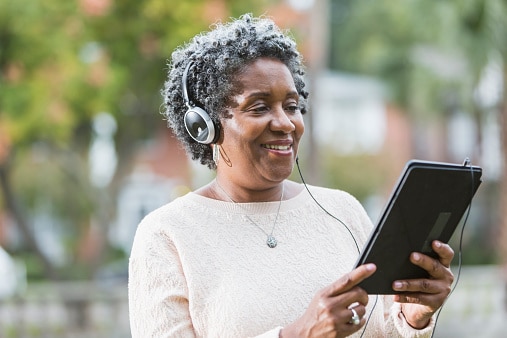
The brain’s hearing center works like a muscle; it needs regular stimulation to stay strong. Just as you will need to rebuild muscle after a few months away from Sunny Isle Yoga, you need to rebuild speech processing skills after a period of untreated hearing loss.
Auditory training is a series of exercises to help your brain get back into the habit of processing speech effectively. Your hearing specialist may recommend it when you first get hearing aids, or if you have central auditory processing disorder, where your ears hear but your brain doesn’t process speech.
How Do Audiobooks Help Speech Processing?
After you get hearing aids, audiobooks can provide the missing stimulation in a familiar, low-pressure way. If you’re new to audiobooks, try the following tips to ease into using them as auditory training:
- Start with a familiar book. If you’re not a quantum physicist, starting with a book on quantum physics will probably not be the easiest. Instead, choose a book you’ve read before and loved. The familiarity will make it easier to follow along.
- Adjust the speed. Audiobook platforms allow you to change the playback speed. Play around with the speed to find one that feels easiest to focus on.
- Follow along. If you can, grab a physical copy of the book you’re listening to and read along with the audio. Doing so will be just like adding subtitles to your TV—it allows you to fill in the gaps where you didn’t quite catch something.
- Take notes. Recall is often harder for people with hearing loss or auditory processing disorder. Try taking down the occasional note to reinforce the theme of the story.
- Think about the voice actor. Hearing loss affects specific frequencies. Because every reader’s voice will have a different pitch to it, you might find some easier to understand than others.
Hearing aids can make audiobooks even more effective! Connect your hearing aids to your phone via Bluetooth® and stream the book directly to your ears for easier listening. If you have questions about using your devices or want to learn more about auditory training, contact Advantage ENT & Audiology today.
[1] National Institute on Deafness and Other Communication Disorders. (2024). Quick statistics about hearing, balance, & dizziness. National Institutes of Health. https://www.nidcd.nih.gov/health/statistics/quick-statistics-hearing